
Tax Sale Writeup 2023
By Chapel Rice
10 Nov 2023
The purpose of this document is to briefly explain what I understand about the Delinquent Tax Sale process. Please understand that I am not qualified to provide investment advice, and that this document is not meant to provide investment advice. Please see an attorney for any legal advice and an accountant for any accounting advice.
The 2023 Lexington County Tax Sale is December 4th. The first list of properties will post November 16th. Here are some links before I get into all this:
- Lexington County Delinquent Tax Page: Delinquent Tax Page
- Lexington County GIS: Lexington County GIS They should eventually highlight the delinquent properties on the map.
- State Law: SC State Law
- The 16% Solution: The 16% Solution This book is interesting, but it does not really go over South Carolina. It is a quick read.
- Richland County Video: Richland County Tax Sale Video
What is the Tax Sale?
Delinquent Tax Sales are a way for County Governments to ensure they collect real estate property taxes in a given year. I will use an example of someone who owes $1,000 in taxes throughout this document, and I will talk about the process in South Carolina. The process is notably different in other states, and even some counties will have differing procedures. Suppose the Property Owner does not pay this tax for a year. The County will mark this bill as delinquent, and they will attempt to notify the Property Owner of the delinquent status and that the property will be taken to Auction if not paid. Multiple notifications will be sent; the list of delinquent properties will be posted in local papers, online, etc. If the bill is not paid by the day of the Auction, the property will be auctioned.
So now a property has made it to auction, to the Tax Sale. There will be a few hundred properties being auctioned, and there will be a few hundred bidders. Bidding will begin at the amount of taxes due. The $1,000 tax bill will be auctioned off. Lets say the highest bid is $10,000. The winning Bidder has until 5pm that day to pay the County $10,000 in Cash or Cashiers Check, or face a fine of $500. So the Bidder pays.
Now begins a one-year period where the delinquent Property Owner can redeem their property by paying the $1,000 tax bill and interest on the bid amount, $10,000. We will cover how the interest works later, but in short it is 12% annually with a max at the amount of the tax bill, i.e. the interest payment for this property is at most $1,000.
So at the end of the one year redemption period, there are two options. The property is redeemed by the Owner, or the Property Owner defaults and the County deeds the property to the Bidder. We will talk about this deed later. If the property is deeded to the Bidder, it is as if the Bidder has bought it for $10,000.
The three parties involved, the Owner, Bidder, and County, all receive the following from this process:
- The Owner – Has their window to pay their taxes extended by one year, although they are obviously in a financially distressed position
- The County – Gets the tax revenue
- The Bidder – Has an investment opportunity which will result in either the return of their bid amount plus an interest payment, or they receive a property at usually a major discount
Explanation of the Payout
In South Carolina, the interest rate on the bid is 12%, but it caps out at the amount of the taxes. The interest ramps up throughout the year on the following schedule after the Auction:
| Months | Interest Rate |
|---|---|
| 1-3 | 3% |
| 4-6 | 6% |
| 7-9 | 9% |
| 10-12 | 12% |
So for the $1,000 tax bill and $10,000 bid discussed previously, the Bidder will receive the following interest payments with the return of their $10,000 bid if the property is redeemed by the Owner:
| Months | Bid | Interest | Payout at Redemption |
|---|---|---|---|
| 1-3 | $10,000 | $300 | $10,300 |
| 4-6 | $10,000 | $600 | $10,600 |
| 7-9 | $10,000 | $900 | $10,900 |
| 10-12 | $10,000 | $1,000 | $11,000 |
Notice that in Months 10-12, even though the interest rate is 12%, which would imply a $1,200 payout, the interest is capped at the tax bill amount, $1,000. This is to protect the Delinquent Property Owner from excessive interest. The most they will have to pay is twice their original tax bill. This, along with the fact that this process is highly illiquid for the Bidder, brings up a question we will discuss briefly later, “How much should a Bidder be willing to tie up in one property?”
What if the Tax Payer Defaults?
In the case of a default by the Tax Payer, the County will deed the property over to the Bidder. The Bidder has now functionally bought the property for the amount he bid for it. This will appear on the county records as a sale for the bid amount, and people can click to see the deed and see that it is a “Tax Deed”, stating that this property was bought through the Tax Sale Process. In 2022, the Auction was on November 8th. The Owner has until November 8th, 2023 to pay, after which they have defaulted. The County will take a few months to deed the property over to the Bidder. I am told it will happen in February of 2024. Notice the timeline of 15 months.
An important thing to note is that this title is “Dirty”. Note that I am not a lawyer, so this explanation is just to the best of my understanding. A “Dirty” title means that there are possibly multiple claims to the property in question. The legal term for this is that the title is “Encumbered”. What this means for the Bidder is that no mortgage can be taken out on this property, making it much more difficult to sell. No Bank will write a mortgage on an encumbered property because no Title Insurer will write a Title Insurance Policy on it. Title Insurance insures the property for any lawsuits where someone else claims ownership of the property. Mortgage companies will always get Title Insurance to protect themselves.
So if no mortgage can be taken out on the property, that means that the sale of the property will either have to be owner financed, or for cash until the property title is “Quieted”. There are Quit Claim sales that can be made in these cases, and you will need to research that if you want to go that route.
To “Quiet” the title in South Carolina, there are two main options. You can either wait 10 years for a “Statute of Limitations” to pass or perform a “Quiet Title Action”.
The reason this is necessary is that, based on some precedents in South Carolina, the Defaulting Property Owner could, in the next 10 years, come forward and say they were not served the proper documents, and that the property was illegally deeded by the County. I am told that in this case, the County is at fault, so the property is deeded back to the Original Owner, and the Bidder is given their bid back and the County foots the bill for the interest. That sounds fine, but it may have been a few years, and any improvements the Bidder made to the property will be given to the Defaulting Property Owner.
A “Quiet Title Action” is a legal procedure where the Bidder will hire a lawyer to research all alternative claims on the property, notify those parties, and set a court date for those parties to come forward and plead their case for why the Tax Deed is invalid. If no one comes forward and proves that the tax deed is invalid, the title is “Quieted”. There is no longer any alternative claims on the property. I am told this action will cost the Bidder about $5,000 and take about 6 months. This could well be worth it in many cases. Suppose the example $1,000 tax bill we have been talking about is on a property with a market value of $100,000. The Bidder now owns it for $10,000, but he may have a hard time finding a buyer who will pay cash or not get a mortgage. For an additional $5,000, he can “Quiet” the title and sell it at full market price soon after, turning $15,000 into $100,000 in maybe less than two years with very little effort on his part. The tax sale is mostly a waiting game.
How Much Should you Bid?
A very important aspect of this process is that the Bidder is making an illiquid investment. The Liquidity of an asset is how quickly/easily it can be converted into cash. The Bidder ties up $10,000 in a property. There is really no secondary market for these Tax Bids, i.e. the Bidder will have a hard time getting that $10,000 back out before the property is redeemed or he sells the property after being deeded it. So you do not want to over-bid on the property.
I think a “10 Times” rule is a good approach. Because the interest payment maxes out at the amount of the tax bill, if the Bidder bids at most 10 Times the tax bill, they will ensure they make at least 10%. Returning to the example earlier, we saw that the effective interest rate capped out at 10% when $10,000 was bid on a bill of $1,000.
| Months | Interest | Effective Annual Rate |
|---|---|---|
| 1-3 | $300 | 12% |
| 4-6 | $600 | 12% |
| 7-9 | $900 | 12% |
| 10-12 | $1,000 | 10% |
This is the rule I will follow when I bid. I will be bidding on mostly residential properties with a tax bill of less than $1,000. I will bid up to 10 times the tax bill, after which I will stop bidding and wait for the next property that I am interested in. This will guarantee me a 10% interest payment or better. I actually did not pull my hand down fast enough last year at the sale, and I over-bid by about $1,000. This lowered my Minimum interest payment from 10% to 8.5%.
If a Bidder is specifically interested in a property, maybe he will be willing to bid much more than is reasonable from an interest perspective. They are hoping to get the property in this case. It is also notable that Commercial Properties get bid up really high. I do not fully understand why that is.
Here are some stats and two Histograms on the 2020, 2021, and 2022 Lexington County Tax Sales:
- The Largest bid was $1,700,000
- The Smallest bid was $1,000, excluding some properties that were not bid on
- The Average Bid was $40,300
- The Median was $14,000
- The Average Bid/Tax Bill was 21.3
- The Median Bid/Tax Bill was 12.4
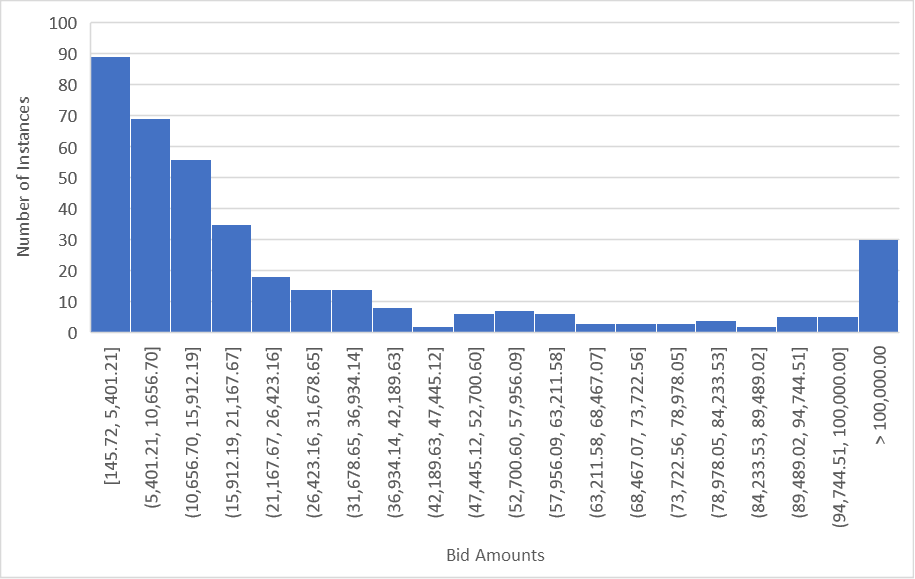
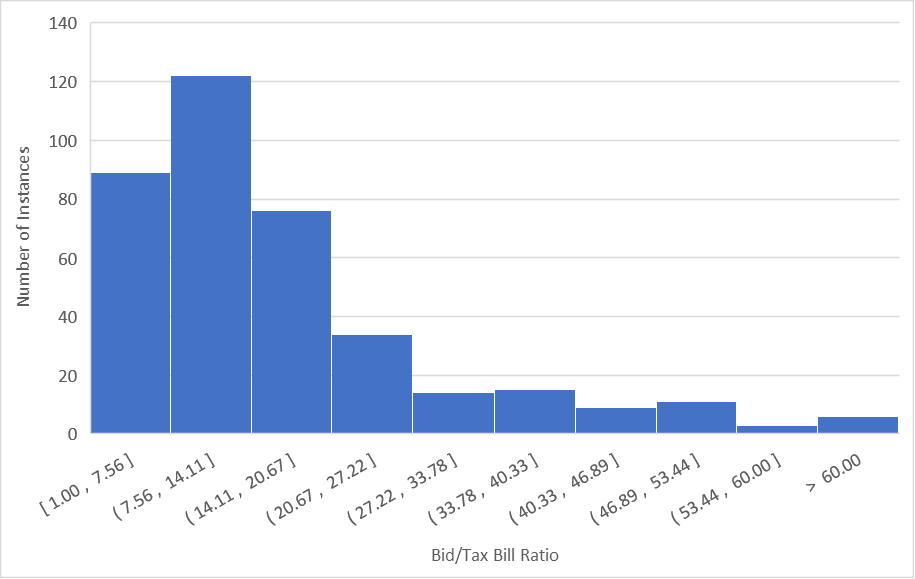
Looking at this data, you can see there are lots of opportunities. Many bids go for less than $5,000 and $10,000. Many go for about 10 times the tax bill. The point here is that there are not huge barriers to entry and many opportunities at many price points.
You should probably assume that the properties will be redeemed, i.e. you should bet on the interest payment. In Richland County, there are about 180,000 properties. About 1,800 go to the tax sale each year, and about 150 will default. Based on that, about 8% of the properties at the auction will default. That is one in 12. Charleston County quotes an 80% redemption rate, which would be one in five will default.
For the sake of speculation, lets assume that this will hold in general; for every property sold at auction, there is an 8%, 1/12, chance that the property will default. Lets also assume that in the case of default, the bidder will make 7.5 times on their money, i.e. a property that was won for $10,000 at auction has a market value of $75,000. 7.5 times is loosely based on an incomplete dataset of Lexington county bid amounts compared to the Zillow “Zestimate” of the property. Lets also assume the “10 Times” rule, meaning that in the case of the property being redeemed, the bidder will make at least 10%. With these assumptions, the average return on a tax sale investment would be about 60% ( [0.08750% + 0.92110%] - 100% = 61.2% ). Note that this calculation makes a lot of assumptions and is “on average”. In general, I would consider receiving a property from the sale a “Home Run” situation, whereas I would expect to normally receive just the interest payment.
An important thing is that the initial delinquent property list will be really long. The list on the day of the sale will be much shorter. Most of the properties you will want personally will not make it to the day of the sale. People with nice properties will usually find a way to pay their bills.
Risks
Every investment is risky; that is why returns are required on them. The primary risk at the tax sale is Liquidity. You have to be willing to tie up $10,000 or whatever you are trying to bid for at least a year, maybe more. If you are going to need that cash in the next year, put it into something more liquid.
There is also a small chance you end up with a terrible property. It is possible that the owners are purposely not paying the taxes because they see no other way of getting rid of the place. With some due diligence, this can be avoided for the most part.
There is also an extremely small chance that you buy an EPA disaster site without knowing it. Again, due diligence can protect from this. That is also much more likely on Commercial properties, which will likely be bid way out of your price range.
Conclusion
In conclusion, the Tax Sale is an investment opportunity enabled by the County so they can get their tax revenue. Bidders either get a great interest payment or there is a small chance that they could get the property for much less than market value.
I will be there December 4th. I encourage everyone to go, and I think $5,000-$10,000 would be a great entry point.
By Chapel Rice